

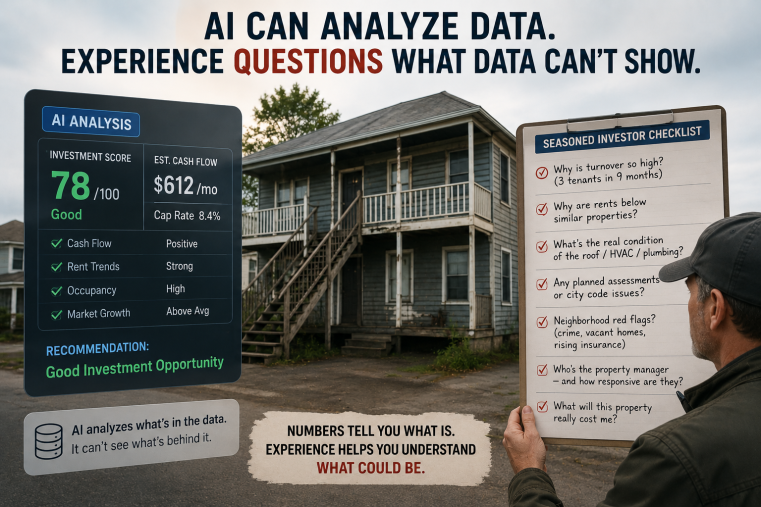
Let’s say you find an eight-unit multifamily for sale, fully occupied. Your back-of-the-napkin analysis suggests that the asking price isn’t ridiculous, so you decide to take the easy road and paste the listing data into an AI tool. A few seconds later a nice summary pops up with cap rate, cash-on-cash, a projected return, and a verdict that says the deal looks “favorable.”
It looks professional. It looks believable. And it might be wrong in ways that really matter.
In the spirit of transparency, I want to be clear that this post is not from an old curmudgeon railing against the latest fad in technology. No, I won’t suggest that you put that 8-track player back in your car dashboard. AI is an incredible tool, and I use it. But like any powerful tool, you must use it with care.
Getting back to that 8-plex. AI can do a Herculean job with the grunt work. If it has web access, it may pull comps, find vacancy stats and prevailing market cap rates, and uncover potential financing terms.
Economists such as Ajay Agrawal and his co-authors have observed that AI collapses the cost of prediction. But while AI can lower the cost of producing an analysis, it does not lower the cost of being wrong.
Where can an AI analysis of an income property go wrong? Start with the listing data, and roll your mind back to the ‘50s phrase, “garbage in, garbage out.” These are the seller’s numbers, and the seller has an agenda.
All of us who have been in this business for any time have encountered this: The rent roll shows what it could be, not what it really is. Repairs and maintenance figures are optimistic. There’s no allowance for property management because the owner self-manages. And reserves for replacement? Probably absent altogether — and even if present, AI can’t walk through the property, so it can’t see the deteriorating roof shingles or the rust at the bottom of the water heaters. And where, exactly, did that compressed exit cap rate come from? GIGO
What if you zoom out to see the bigger picture? Is a major employer about to shut down, impacting the demand for apartments or the ability of current tenants to pay their rent? Are new multifamily projects on the drawing board in this market that will compete with this property a few years out?
A strictly AI-dependent analysis may not pick up on things like this. It does a great job of crunching the numbers you gave it, but it doesn’t have peripheral vision. It produces a plausible answer, given what it knows.
In my university classes and in my online courses, I spoke often about how you must learn to look for the story behind the data, or as I said it there, look for the picture behind the picture.
A seasoned investor reads that same set of numbers and starts to scrape away at that surface.
- Do you agree with the projections for future rent and expense increases?
- What is the seller’s motivation?
- Can you see the actual leases?
And if this were a commercial property, you would also be looking at the viability of the businesses on those leases.
AI gave you a confident answer to the question you asked. It couldn’t tell you that you might not be asking all the right questions.
This is where the real skill shows up, and I’m concerned that investors who are new to the business will stop developing these skills precisely because the tool is so good. AI gives you a credible first analysis, and that’s a useful thing to have. But knowing that some of the seller’s data is wishful thinking, and then revising your numbers downward to account for it requires that you already understand the dynamics underneath. You can’t correct a tool you don’t understand. You can only trust it, which is a different thing entirely, and a more dangerous one.
AI may be able to help you develop the base analysis. What’s left for you is the harder part: judging the analysis. Deciding how much to accept as is, how much to reconstruct. That’s a higher-order skill, and it’s not one you can pick up by watching an AI tool do its thing. You learn it the old way, by understanding what each number means, where it comes from, and how it behaves when reality gets its hands on it.
Whatever AI shaves off the cost of producing an analysis, it shaves nothing off the cost of being wrong about one.
So the better these tools get, the more they reward the investor who understands the fundamentals, and the more they punish those who don’t take the time or effort to learn. There will still be winners and losers. That hasn’t changed at all.
None of this means avoiding the tool. It means arriving at it prepared. In a companion article, I plan to show what that preparation buys you in practice: the prompts, the guardrails, and the kind of disciplined analysis you can actually use to decide whether to purchase, pass, or negotiate.
A closing note. Everything above assumes one thing: that you already know enough to tell a good analysis from a convincing one. That knowledge — how the numbers behave, what the metrics mean, where deals quietly go wrong — is exactly what the courses on this site are built to teach. AI is really good at math. These courses are about becoming the investor who knows whether to believe it.
This article is educational and not financial, investment, tax, or legal advice. AI-generated analysis can contain errors; verify all figures against primary sources: actual leases, tax records, insurance quotes, inspections; and consult qualified professionals before any investment decision.